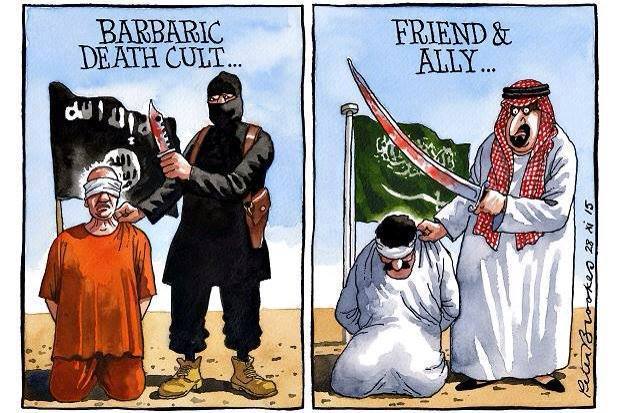
Saudi is a country with a lot of oil, a lot of tribes and a lot of princes. The ruling family is concerned about soldiers with tribal loyalty which make a coup d'état possible. Then there is the religion, a particularly nasty form of Islam called Wahhabi after its founder. See more at Saudi Arabia Is Wrong. The current situation in 2016 with oil prices low is explained(?) at Saudi’s Three Great Pillars Are Showing Cracks. It doesn't tell us why petrol prices are staying high though. That is the greed of Big Oil & Big Government.
From
http://mondoweiss.net/2011/02/can-you-pass-the-saudi-arabia-quiz.html - The
main source quoted here is
Inside the Kingdom
by Robert Lacey - Mondoweiss is run by a Jew.
Well informed commentary comes from Mark Steyn headlined The Man Who Put The Saud In Saudi Arabia. His exports are Oil and Wahhabi, a nasty, Puritanical version of Islam. We need the oil so we tolerate the Islam. In fact it is worse. The Puppet Masters import Arab thugs to use as weapons against us.
Can You Pass The Saudi Arabia Quiz?
QUOTE
Saudi Arabia, an Islamic absolute monarchy, has enjoyed extremely close relations with the United States, a constitutional republic. This relationship highlights the gross hypocrisy of US foreign policy: fundamentalism and dictatorship in the Arab world is only condemned when it comes garbed in anti-Americanism. In fact, Saudi Arabia makes Iran—the target of sanctions and regime change by the US for over 30 years—look relatively progressive.The US and Saudi governments have had a clear long-term agreement. The Saudis agree to supply oil in accordance with US needs and to reinvest the resulting revenue in US assets and arms. In return, the US provides protection to the Royal family regardless of its internal repression and extremist ideology. While mutually beneficial, this compact is also the source of one of Saudi Arabia’s great contradictions: The Saudi kings depend for their security on a country widely reviled in the Arab world as Israel’s protector.
Contradictions run deep in Saudi Arabia. Attempts at domestic reform have been confronted with state-sponsored extremist preachers—in fact, Saudi kings have, on occasion used their power to protect “progressives” from harsh Saudi judges. While in the foreign policy realm, uneven state support of confrontational policies concerning Iran have been coupled with attempts to moderate US belligerence in Iraq and Palestine............
4. Why, despite spending billions on military equipment, is the Saudi state unable to defend itself?
-“Even after Saudi oil was fully nationalized in 1980, Washington’s politico-military elite maintained their pledge to defend the existing Saudi regime and its state whatever the cost. Why…could the Saudi state not defend itself? The answer was because the Saud clan, living in permanent fear, was haunted by the spectre of the radical nationalists who had seized power in Egypt in 1952 and in Iraq six years later. The Sauds kept the size of the national army and air force to the barest minimum to minimize the risk of a coup d’état. Many of the armaments they have purchased to please the West lie rusting peacefully in desert warehouses. For a decade and a half in the late 1970s and ‘80s, the Pakistan army, paid for by the Saudi treasury, sent in large contingents to protect the Saudi royal family in case of internal upheavals. Then, after the first Gulf War, the American military arrived.” (Tariq Ali; The Duel: Pakistan on the Flight Path of American Power; Scribner; New York: 2008; p. 265.)-“Relatively small in number, in order to minimize the domestic risk of a republican coup d’état of the kind that brought down monarchies in Egypt, Iraq, and Libya, it [the Saudi military] is impressively armed with equipment bought at prohibitive prices in what has proved to be a bonanza for Western cannon merchants. Thus, for a population four times the size of that of neighboring Jordan, the Saudi kingdom has barely twice as many personnel in its armed forces, but it spends thirty-three times what the Hashemite kingdom spends on its own military budget. … Much of Riyadh’s most advanced weaponry is ‘pre-positioned’ so as to be available for eventual use by the U.S. troops… It is an open secret that the huge airport at Jeddah is not designed merely for the transit of pilgrims to Mecca.” (Gilbert Achcar; Eastern Cauldron: Islam, Afghanistan, Palestine, and Iraq in a Marxist Mirror; Monthly Review Press; New York: 2004; pp. 71-72.)
-“The original function of the [Saudi National] Guard was to enlist the loyalty of the tribes to protect the royal family against any threat… The Guard was founded at a time of suspected military coups, so its first bases were sited close to Riyadh and the major cities. The idea was that the Guard could block hostile forces coming from the more distant army and air force bases on the borders. Its anti-aircraft weapons were designed to shoot down Saudi fighter planes. Its antitank rockets had to be good enough to take on the Saudi Army.” (Robert Lacey; Inside The Kingdom: Kings, Clerics, Modernists, Terrorists, and the Struggle for Saudi Arabia; Viking; Toronto: 2009; p. 184.)
-Note that the respective populations of Israel and Saudi Arabia are 7.6 million (75% are Jewish) and 25.7 million (including 5.6 non-nationals). Therefore, Saudi Arabia has the population to more than match Israel’s military..........
-The issue of “control of oil” is fundamental. It is why the US accepts Saudi Arabia being China’s principal supplier of crude oil and why it accepts Russia-Saudi joint ventures connected to oil.
-Saudi Arabia has the world's largest oil reserves and is the world's largest oil exporter. Oil accounts for more than 90% of exports and nearly 75% of government revenues, facilitating the creation of a welfare state. (http://saudinf.com/main/d1.
htm)
7. True or False: In the early 1960s, a group of Saudi princes flew to Cairo and called for constitutional democracy for Saudi Arabia.
-True. As the Al-Saud splintered in the late 1950s under the challenge of Arab nationalism and the charismatic Nasser, a group of radical young princes campaigned for constitutional democracy. “Prince Talal was one of a group of reformers and leader within the royal family known as the Free Princes. In 1958 he wrote a proposed constitution for Saudi Arabia which would have created a constitutional monarchy and expanded civil rights. He began to assemble an elected advisory committee, but his ideas were rejected by the king, and religious leaders in Saudi Arabia issued a fatwa declaring his constitution to be contrary to Islamic law. In 1961 the kingdom revoked his passport and attempted to silence him, but he expatriated to Egypt and declared himself a socialist. There, influenced by Gamal Abdel Nasser, Talal continued to push for reform and criticize the leadership of the Kingdom. In1964 Talal agreed to temper his criticisms in exchange for permission to reenter Saudi Arabia. He is now a successful businessman… Prince Talal resumed his push for reform in Saudi Arabia in September 2007, when he announced his desire to form a political party (illegal in Saudi Arabia) to advance his goal of liberalizing the country.”
Talal bin Abdul-Aziz 8. What event led to Saudi Arabia and other Arab oil-producing countries imposing an oil embargo on the US and Europe in the early 1970s?
-In 1973, “[K]ing Faisal of Saudi Arabia announced a boycott on his kingdom’s oil sales to the United States. Enraged by President Richard Nixon’s military support for Israel in the October War against Egypt and Syria, the Saudi king had hoped to compel some dramatic change in U.S. policy. Yet as the Arab oil boycott caused the price of oil on the world market to multiply nearly five times, it was back home, inside the Kingdom, that the truly dramatic changes would occur. … After centuries of hibernation and a few recent decades of only gradual change, Saudi Arabia was suddenly turned on its head. Foreign money brought foreign ways—the good, the bad, and, in the eyes of many Saudis, the very definitely ugly. Women started appearing on TV… [The] pure world [of the pious] was under threat.” “[A]ll over the Arab world in the 1970s…Muslims worked out their different responses to the material and spiritual inroads of the West. Those who opted for back-to-basics called themselves Salafi…” (Robert Lacey; Inside The Kingdom: Kings, Clerics, Modernists, Terrorists, and the Struggle for Saudi Arabia; Viking; Toronto: 2009; pp. 3-4 and 9.)
9. What three events in 1979 greatly affected Saudi Arabia’s domestic and foreign policies?
(i) The invasion and occupation of the Grand Mosque in Mecca on November 20, 1979 by five hundred Wahhabi fanatic salafis. The siege ended on December 4. All the surviving men were beheaded. The government lost 127 soldiers dead and 461 injured; 117 Salafi rebels were also killed. “Since the early 1960s the House of Saud had been on the lookout for trouble—investigating and arresting Communists, socialists, and ‘godless’ radicals of all sorts. Serious opposition, everyone anticipated, would be coming from the left. But the attacks of 1979 had come from the very opposite direction—from those on the right… ‘Godless’ was the reproach that was now being thrown at the king and princes… [The rebels] had been nurtured in the traditional territory of Wahhabi mosques…" (Robert Lacey; Inside The Kingdom: Kings, Clerics, Modernists, Terrorists, and the Struggle for Saudi Arabia; Viking; Toronto: 2009; pp. 34-35 and 46.)
10. Why did Osama Bin Laden, who had been in sync with Saudi state policy in the 1980s, turn against the Saudi government?
-“When the news had come through of Saddam’s invasion [of Kuwait] in August 1990, Osama Bin Laden knew exactly how he could help. He got in touch with the comrades who had fought with him in Afghanistan… He and his mujahideen companions had defeated the Soviets… Now they would chase…Iraqis…back to Baghdad. … When the House of Saud turned down Osama’s mujahideen in favor of the godless Americans…They offended his religious beliefs—and those of many other pious Saudis.”
It should not be forgotten that in the mid-1980s, Bin Laden was a hero in Saudi Arabia as he was using his wealth to help a noble cause—kicking the Russians out of Afghanistan—which was supported by the Saudi and American governments. To many Arabs “It was a new and very pleasant sensation…to feel they had played their part in a military victory. ‘Progressive’ Arab leaders like Nasser and Sadat had flung well-armed Arab armies against Israel, and had delivered humiliation. They had not included religion in their strategy. But now victory was going to those who grounded themselves in Islam. Small and simple groups of holy warriors were humbling one of the world’s two superpowers.” “In 1988 the Russians started withdrawing, and on February 15, 1989, the Soviet Union announced that the last of its soldiers had left the country. It was an extraordinary defeat… But the victors interpreted its roots and reasons in different ways. Within months the West was celebrating the scarcely believable collapse of the entire Soviet monolith. [While the West celebrated capitalism and deterrence]…Saudis remembered their prayers…”
11. Jihadi manuals, used by the mujahideen in Afghanistan and elsewhere, were produced in the early 1980s by which country?
-The United States of America. “In the twilight of the Cold War, the United States spent millions of dollars to supply Afghan schoolchildren with textbooks filled with violent images and militant Islamic teachings, part of covert attempts to spur resistance to the Soviet occupation. The primers, which were filled with talk of jihad and featured drawings of guns, bullets, soldiers and mines, have served since then as the Afghan school system's core curriculum. Even the Taliban used the American-produced books… [The U.S. is] now…wrestling with the unintended consequences of its successful strategy of stirring Islamic fervor to fight communism. What seemed like a good idea in the context of the Cold War is being criticized by humanitarian workers as a crude tool that steeped a generation in violence. … Published in the dominant Afghan languages of Dari and Pashtu, the textbooks were developed in the early 1980s…[at] the University of Nebraska-Omaha…Today, the books remain widely available in schools and shops, to the chagrin of international aid workers. ‘The pictures [in] the texts are horrendous to school students…’ One page from the texts of that period shows a resistance fighter with a bandolier and a Kalashnikov slung from his shoulder. The soldier's head is missing. Above the soldier is a verse from the Koran. Below is a Pashtu tribute to the mujaheddin, who are described as obedient to Allah. Such men will sacrifice their wealth and life itself to impose Islamic law on the government, the text says.” (http://www.washingtonpost.
com/ac2/wp-dyn/A5339- 2002Mar22?language=printer) 12. Which three countries were the first to officially recognize the Taliban government in Afghanistan?
-“By the end of September 1996 the Taliban had conquered Kabul and had extended their rule to twenty-two of the country’s thirty-one provinces. They announced that their godly government would be known as the Islamic Emirate of Afghanistan, and while most of the world prudently stepped back and waited, three countries granted this unusual entity official recognition: Pakistan, the United Arab Emirates—and Saudi Arabia.” The Taliban began issuing prohibitions: “no kite flying, no pool tables, no music, no nail polish, no toothpaste, no televisions, no beard shaving… [T]he Taliban also…closed all girls’ schools and colleges, and banned women from working… These draconian regulations were enforced by religious police squads…that were built directly on the Saudi model of fundamentalist vigilantes and drew support from Saudi religious charities.” “At the end of July [1998] the Taliban…[finally captured] Mazar-e Sharif. This historic center of Shia worship…had resisted Taliban attacks…and was now punished with a series of ghastly reprisals. Ahmed Rashid later estimated that six thousand to eight thousand Shia…were slaughtered in a rampage of murder and rape that included slitting people’s throats and bleeding them to death, halal-style, and packing hundreds of victims into shipping containers without water, to be baked alive in the desert sun.” “Not for the first or last time, Saudi favor to Islamic purists had helped give birth to a monster…” (Robert Lacey; Inside The Kingdom: Kings, Clerics, Modernists, Terrorists, and the Struggle for Saudi Arabia; Viking; Toronto: 2009; pp. 199-201 and 209-10.)
-"When [in 1996] the Taliban religious movement decided to stone to death a couple caught in adultery, it chose a blazing afternoon in late August. … The condemned woman, Nurbibi, 40, was lowered into a pit dug into the earth beside the wall until only her chest and head were above ground. … [After the judge threw the first stone,] Taliban fighters who had been summoned for the occasion stepped forward and launched a cascade of stones…" (http://middleeast.about.com/
od/afghanistan/fr/taliban- ahmed-rashid.htm) 13. When the Taliban took power, who said he saw "nothing objectionable" in their plans to impose strict Islamic law?
-Glyn Davies: State Department spokesperson.
-“The U.S. government was well aware of the Taliban's reactionary program, yet it chose to back their rise to power in the mid-1990s. The creation of the Taliban was ‘actively encouraged by the ISI and the CIA,’ according to Selig Harrison, an expert on U.S. relations with Asia. ‘The United States encouraged Saudi Arabia and Pakistan to support the Taliban, certainly right up to their advance on Kabul,’ adds respected journalist Ahmed Rashid. When the Taliban took power, State Department spokesperson Glyn Davies said that he saw ‘nothing objectionable’ in the Taliban's plans to impose strict Islamic law, and Senator Hank Brown, chair of the Senate Foreign Relations Subcommittee on the Near East and South Asia, welcomed the new regime: ‘The good part of what has happened is that one of the factions at last seems capable of developing a new government in Afghanistan.’ ‘The Taliban will probably develop like the Saudis. There will be Aramco [the consortium of oil companies that controlled Saudi oil], pipelines, an emir, no parliament and lots of Sharia law. We can live with that,’ said another U.S. diplomat in 1997. The reference to oil and pipelines explains everything. … Afghanistan itself has no known oil or gas reserves, but it is an attractive route for pipelines leading to Pakistan, India, and the Arabian Sea. In the mid-1990s, a consortium led by the California-based Unocal Corporation proposed a $4.5 billion oil and gas pipeline from Turkmenistan through Afghanistan to Pakistan. But this would require a stable central government in Afghanistan itself. Thus began several years in which U.S. policy in the region centered on ‘romancing the Taliban.’” (http://www.
thirdworldtraveler.com/ Afghanistan/Afghanistan_CIA_ Taliban.html) 14. From the US invasion of Iraq in 2003 to 2007, what percentage of known suicide-bombers in Iraq were of Saudi origin? Iranian origin?
-Saudi origin: 43%; Iranian origin: 0%. (http://www.mcclatchydc.com/
2007/08/08/18791/studies- suicide-bombers-in-iraq.html) 15. How many Wahhabi suicide bombers had there been before 1980?
-None. “There were no Wahhabi suicide bombers until after the Reagan administration launched its struggle, with the help of the mujahideen, against the Soviets in Afghanistan, and there is no warrant in Wahhabism for suicide, or it would not have taken 150 years for it to occur to a Wahhabi fighter to sacrifice himself in that way. It is wrong to tar all the members of a religious tradition with the brush of terrorism based on the actions of a small number of persons among them.” (Juan Cole; Engaging The Muslim World; Palgrave Macmillan; New York: 2009; p. 111.)
16. True or False: Saudi Arabia was instrumental in putting forward a comprehensive peace plan with Israel—that was formally adopted by the entire Arab League—that offered Israel full recognition and normal relations.
-True. “During a February 2002 interview the crown prince [Abdullah] startled…columnist Thomas Friedman by…[producing] a fully worked-out peace proposal that offered Arab recognition of Israel and normalization of relations in exchange for an Israeli return to its pre-1967 borders. A few weeks later Abdullah went to Beirut to push his peace plan through the twenty-two-member Arab League summit—the most developed and comprehensive Arab olive branch ever. … [P]rivate polling inside Israel [done by a company not told it was for Saudi Arabia]…found that 70 percent of Israelis thought that the Abdullah peace plan was a fair deal.” (Robert Lacey; Inside The Kingdom: Kings, Clerics, Modernists, Terrorists, and the Struggle for Saudi Arabia; Viking; Toronto: 2009; p. 285.)
-In March 2002, the Arab League summit in Beirut unanimously put forth a peace initiative that commits it not just to recognize Israel but also to establish normal relations once Israel implements the international consensus for a comprehensive peace—which includes Israel withdrawing
from the occupied territories and a just settlement of the Palestinian refugee crisis. (This peace initiative has been subsequently reaffirmed including at the March 2009 Arab League summit at Doha.) All 57 members of the Organization of the Islamic Conference, including Iran, "adopted the Arab peace initiative to resolve the issue of Palestine and the Middle East…and decided to use all possible means in order to explain and clarify the full implications of this initiative and win international support for its implementation." (Norman G. Finkelstein; This Time We Went Too Far: Truth and Consequences of the Gaza Invasion; OR Books; New York: 2010; p. 42.) -“[T]he proposal…was never taken seriously by the expansionist government of Ariel Sharon, nor by the stridently pro-Israeli politicians in Washington.” (Juan Cole; Engaging The Muslim World; Palgrave Macmillan; New York: 2009; p. 103.)
-Saudi Arabia is concerned that its US ally is largely hated in the Arab world due to its invasion and occupation of Iraq, blatantly pro-Israel stance and other policies. Accordingly, King Abdullah has attempted to resurrect his Arab-Israeli peace plan, reconcile Hamas and the PLO, and pursue other policies to diminish Iran's influence in the region. (The Saudi rulers had warned against the 2003 US invasion of Iraq as they were concerned that the venture could lead to increasing Iran’s power in the region.) “Instead of attempting to enlist Saudi Arabia in vendettas, as the Bush administration did, pitting Saudis and their Sunni allies in Lebanon against the Iran-backed Shiite Hizbullah (which ended badly in May 2008 when Hizbullah militiamen demonstrated that they could take over all of Beirut if they so chose), or attempting to set Saudi Arabia and other Gulf oil monarchies against Iran, the United States should see the Saudis as the ultimate potential peace brokers in the region.” (Juan Cole; Engaging The Muslim World; Palgrave Macmillan; New York: 2009; p. 112.)
17. What was the unemployment rate in Saudi Arabia in 2010?
-According to the CIA World Factbook, the estimated rate is 10.8%. The rate is for Saudi males only. Some unemployment estimates range as high as 25%. (https://www.cia.gov/library/
publications/the-world- factbook/fields/2129.html) -Saudi Arabia has an unemployment problem for several reasons. "In reality, income generated from exporting...high priced primary commodities [such as oil] enhances the value of the local currency, which in turn makes other potential exports...more expensive...[thus] destroying jobs. ... Other roots of unemployment include the kingdom's extremely high population growth rate...and [the practice] whereby individual Saudis bring foreign workers into the country, taking jobs away from citizens. ... There is plenty of poverty in Saudi Arabia. ... King Abdullah has responded to this challenge by embarking on projects such as the building of an entirely new city of 2 million, aiming to provide a million jobs to Saudis, and by developing industries such as aluminum, steel, fertilizer, and petrochemicals so as to diversify the economy." (Juan Cole; Engaging The Muslim World; Palgrave Macmillan; New York: 2009; pp. 93-95.)
-“The unrestricted entry of cheap foreign workers had flooded the Saudi labor market with millions of third-world workers who were willing to live in primitive camps and to work for…$190 per month. This was a third of the amount on which a Saudi could survive, and the logical solution—that young Saudis should be trained to work as managers—was handicapped by the rising generation’s embarrassing deficiencies in education, particularly when it came to practical knowledge and independent reasoning skills. The teaching of math, science, and English…had been drastically reduced in the early 1980s to make room for the extra religious classes that featured learning by rote… Small wonder that the vision of jihad in foreign lands offered purpose and excitement that attracted many a frustrated young [man]…” “Public beheadings today are disciplinary displays intended to make a point to the ever-swelling community of migrant workers—some ten million, legal and illegal, in a population of twenty-eight million—and the grim deterrent seems effective. By day or by night, you can walk the streets of any Saudi town without fear of muggers. People leave their cars unlocked. Gun crime against or between locals is virtually nonexistent…” (Robert Lacey; Inside The Kingdom: Kings, Clerics, Modernists, Terrorists, and the Struggle for Saudi Arabia; Viking; Toronto: 2009; pp. 192 and 317.)
-“Domestically, Saudi Arabia faces the challenges of unemployment, an exploding population, a growing gap between rich and poor, rapid urbanization and an information revolution that has bypassed the rulers. Although Saudi Arabia shares many of the conditions that have bred the [2011] democracy uprisings—including autocracy, corruption and a large population of educated young people without access to suitable jobs—its people are cushioned by oil wealth and culturally resistant to change.” In other words, unlike other Arab countries, the ruling families in the Persian Gulf region can use cradle-to-grave benefits to co-opt opponents and preempt change. (http://www.nytimes.com/2011/
02/20/world/middleeast/ 20saudi.html?_r=1&hpw) -For a sense of the degree of corruption that has prevailed in Saudi Arabia, consider that "an investigation by the [UK's] SFO [Serious Fraud Office] into alleged payments of as much as £1bn made by [arms manufacturer] BAE to Prince Bandar bin Sultan…was dropped in 2006 after the intervention of the then Prime Minister, Tony Blair. The Government claimed that investigating the £43bn Yamamah deal would threaten the UK's national security." (http://www.independent.co.uk/
news/business/news/bae- protesters-win-sfo-injunction- 1914892.html)
18. Which is the only Muslim-majority state to forbid the building of churches?
-"Among the nearly 60 Muslim-majority states in the world, only one, Saudi Arabia, forbids the building of churches." (http://www.juancole.com/2009/
11/swiss-islamophobia-betrays. html) -Saudi Arabia is also the only country where women cannot drive (and where men can vote in municipal elections but women cannot). (http://www.juancole.com/)
-Observers are correct to discern hypocrisy whenever the US government attacks Iran for being undemocratic and abusive towards its own citizens since “The [Saudi] kingdom is run as an absolute monarchy. It does not allow freedom of religion or of speech. It discriminates against religious minorities. It imposes strict gender segregation… It represses political dissidents.” However, such repression is not due to Islam—since many Muslim countries have far better human rights records—but due to the Saudi regime and Saudi culture. (Juan Cole; Engaging The Muslim World; Palgrave Macmillan; New York: 2009; p. 95.)
-“[I]n Saudi Arabia the law actually enshrines the principle that the male knows better than the female. A woman nay not enroll in university, open a bank account, get a job, or travel outside the country without the written permission of a mahram (guardian) who must be a male blood relative—her father, grandfather, brother, husband, or, in the case of a widow or separated woman, her adult son.” “Since 9/11 women have the right to work in the private sector, but like any other activity outside the home, they can do it only with the written permission of their…male guardian.” (Robert Lacey; Inside The Kingdom: Kings, Clerics, Modernists, Terrorists, and the Struggle for Saudi Arabia; Viking; Toronto: 2009; pp. 277 and 325.)
19. Who wrote the following about a conversation he had with Saudi King Faisal at a state dinner?: "[The King informed me that] Jews and Communists were working…together, to undermine the civilized world as we knew it. Oblivious to my [Jewish] ancestry—or delicately putting me into a special category—Faisal insisted that an end be put once and for all to the dual conspiracy of Jews and Communists. The Middle East outpost of that plot was the State of Israel, put there by Bolshevism for the principal purpose of dividing America from the Arabs."
-Henry Kissinger: United States Secretary of State, 1973-1977. (http://www.danielpipes.org/
995/the-scandal-of-us-saudi- relations) -Robert Jordan, Bush’s ambassador to Saudi Arabia, discovered the depth of conspiracy thinking among Saudis when he arrived in Riyadh a few weeks after 9/11 to take up his post. “Many senior princes believed it was a Jewish plot. Nayef (the interior minister) actually said it was a Zionist conspiracy in a public statement. Even Abdullah was suspicious. They had latched onto this report that three thousand Jewish employees had not gone into work that day. It was an urban myth that has since been discredited, but at the time it was the only way they could make sense of it. … To accept that [many Saudis were involved with the 9/11 attacks]…was like accepting that your son was a serial killer.” (Robert Lacey; Inside The Kingdom: Kings, Clerics, Modernists, Terrorists, and the Struggle for Saudi Arabia; Viking; Toronto: 2009; p. 228.)
-The terror attacks inside Saudi Arabia during the early 2000s, “were the work of Saudi jihadis who had been driven out of Afghanistan by the U.S.-UK invasion in the months following 9/11. The demolition of their Afghan training camps forced several hundred extremists back to the Kingdom, where they regrouped in safe houses as ‘Al-Qaeda in the Arabian Peninsula,’ taking orders via coded phone messages from their leaders, who had gone into hiding in the tribal territories along the Afghani border. Osama Bin Laden…ordered them to take the battle to the Al-Saud on their home territory.” “Prince Nayef may have blamed 9/11 on the Zionists, but now his Ministry of the Interior went for the terrorists with ruthless efficiency.” (Robert Lacey; Inside The Kingdom: Kings, Clerics, Modernists, Terrorists, and the Struggle for Saudi Arabia; Viking; Toronto: 2009; pp. 245 and 248.)
-In contrast to how the U.S. has treated its prisoners, Saudi Arabia has adopted a liberal and progressive rehab program. According to Prince Nayef, the architect of the program, “Some people say that our rehab program is too soft—that we should build a sort of Saudi Guantanamo to punish them. But that is just what Al-Qaeda would like. … If we used the old, harsh ways, then they would draw sympathy and the extremists would take advantage of that to try to get more people involved in terrorism. … We are building a national consensus that extremism is wrong. … [W]e have had…[many] young men surrender themselves because their families brought them in. Whoever wins society will win this war.” (Robert Lacey; Inside The Kingdom: Kings, Clerics, Modernists, Terrorists, and the Struggle for Saudi Arabia; Viking; Toronto: 2009; pp. 255 and 257-8).
21. What is the Shia population of the oil-rich Eastern Province of Saudi Arabia?
-Saudi Arabia is the world’s largest oil exporter, with one-quarter of the world’s proven oil reserves, mostly in the Eastern Province, home to the giant government-owned oil corporation Saudi Aramco. Oil accounts for 75% of budget earnings, approximately 45% of GDP and 90% of exports. Today, China and Japan are its biggest customers. The kingdom also has huge reserves of natural gas. The government is making efforts at diversifying the economy into power generation, telecom, and petrochemical industries. (Nicholas Buchele; Culture Smart Saudi Arabia; Random House; Canada: 2008; p. 49.)
Jeffrey Rudolph, a college professor, was the Quebec representative of the East Timor Alert Network, and presented a paper on its behalf at the United Nations. He has prepared widely-distributed quizzes on Israel-Palestine, Iran, Hamas, and Terrorism which can be found, respectively, at: http://www.countercurrents.
org/rudolph180608.htm;http://www.countercurrents. org/rudolph240410.htm; http://www.countercurrents. org/rudolph250610.htm; and, http://www.countercurrents. org/rudolph080810.htm.
Iran Is Right - Saudi Arabia Is Wrong
Zaher Mahruqi tells us that Saudi panders to the West. Saudi gets blamed for American evil. Iran does not. Iran get aggravation. Zionist crazies are inciting war against Iran, which is just one of the problems. Israel is run by War Criminals, who keep committing Crimes against peace but they are protected by American politicians. Their crimes do not matter.
Saudi Attacks Yemen Putting Oil At Risk [ 31 March 2015 ]
It is Shia Islam versus Sunni Islam or vice versa. At events Islamic factions are at war with each other. This would not matter if it did not endanger the oil fields in Saudi Arabia. We know Cameron Claims Islam Is A Religion Of Peace. We also know that Cameron is a liar.
Saudi Offers To Build 200 Mosques For Criminal Invaders In Germany [ 15 September 2015 ]
QUOTE
Saudi Arabia, which doesn't permit the construction of churches but finances a mosque construction spree in the land of the infidel, will not be taking in Syrian refugees. Even though they are fellow Muslims. It will however offer to build 200 mosques in Germany for their use.It's a kind offer. The only proper way for Europe to reciprocate would be to send a million soccer hooligans to Saudi Arabia and then offer to build facilities to teach them of the importance of trashing the country and abusing any native they come across.
UNQUOTE
Somebody makes lots of sense. The sad reality is that Saudi Arabia has Oil, lots of it. We need it. Annoying them would cause problems.
Saudi prince unveils sweeping plans to end ‘addiction’ to oil [ 25 April 2016 ]
Oil prices have gone down. They might well stay down. Fracking will tend to keep it there even though it is not Easy Oil. At need it will become Big Oil.
QUOTE
The powerful young prince overseeing Saudi Arabia’s economy unveiled ambitious plans on Monday aimed at ending the kingdom’s “addiction” to oil and transforming it into a global investment power.Deputy Crown Prince Mohammad bin Salman said the world’s top oil exporter would raise the capital of its public investment fund to 7 trillion riyals ($2 trillion) from 600 billion riyals ($160 billion) and would sell up to five per cent of shares in state oil giant Aramco.
The plans also included changes that would alter the social structure of the ultra-conservative Muslim kingdom by pushing for women to have a bigger economic role and by offering improved status to resident expatriates.
“We will not allow our country ever to be at the mercy of commodity price volatility or external markets,” Prince Mohammed said at his first news conference with international journalists, who were invited to a Riyadh palace for the event.
“We have developed a case of oil addiction in Saudi Arabia,” he had earlier told al-Arabiya television news channel.
His “Vision 2030″ envisaged raising non-oil revenue to 600 billion riyals ($160 billion) by 2020 and 1 trillion riyals ($267 billion) by 2030 from 163.5 billion riyals ($43.6 billion) last year. But the plan gave few details on how this would be implemented, something that has bedevilled previous reforms.
The 31-year-old prince gave assured answers to questions on the plan, and appeared to pitch his comments to appeal across the Saudi social spectrum, and in particular to young people, who face unemployment and an economic downturn despite their country’s oil wealth.
Even before oil prices started to plunge in 2014, economists had regarded Riyadh’s fiscal policy and economic structure as being unsustainable, but reduced income from energy sales has made reform more urgent.
At the centre of the plan is the restructuring of its Public Investment Fund (PIF), which Prince Mohammed said would become a hub for Saudi investment abroad, partly by raising money through selling shares in Aramco.
OPENING ARAMCO ACCOUNTS
The partial privatisation of Aramco was also central to the plans, and Prince Mohammed said it would be transformed into an energy company that he expected to be valued at $2 trillion to $3 trillion, and that less than 5 per cent of it would be listed on the stock market.So big is the state oil company because of its rights to the kingdom’s crude reserves, that selling even 1 per cent of its value would create the biggest initial public offering (IPO) on earth, he said.
He said other Aramco subsidiary companies would also be listed along with other publicly held companies, and added that one major benefit of privatisation was that it would increase transparency and help limit corruption.
“People used to be unhappy that files and data of Aramco are undeclared, unclear and not transparent. Today they will be transparent. If Aramco gets IPO-ed that means it has to announce its statements of accounts,” he said.
Since the prince was appointed to oversee Saudi long-term planning through the Council of Economic and Development Affairs, Riyadh’s focus on reform has grown far more urgent and far more acute.
Prince Mohammed has enjoyed a dizzyingly rapid rise since his father became king 15 months ago, from being little known outside the ruling Al Saud family to become the driving force of Saudi plans to prepare for a future after oil.
In his rare press conference, he presented himself as a modernising leader who seeks to shake Saudi Arabia out of its economic slumber and its reputation for opacity and rigid bureaucracy, showing an interest in topics including education, the public role of women, and football.
The government ran a deficit of 367 billion riyals ($98 billion) or 15 per cent of gross domestic product in 2015, officials said, and this year’s budget plan aimed to cut that to 326 billion riyals ($87 billion).
His economic team has already announced efforts to curb wasteful government spending, to diversify revenue streams by introducing sales tax and privatising state assets, and to make reforms in the education sector.
Such was the speculation among Saudis over the details of the plan that hashtags associated with it were the top two trending on Twitter on Monday in the country with the highest rate of social media use in the Middle East.
But ambitious targets, such as raising the private sector share in the economy to 60 per cent from 40 per cent, reducing unemployment to 7.6 per cent from 11 per cent and growing non-oil income to 1 trillion riyals ($267 billion) from 163 billion riyals ($44 billion) were not explained further.
PLANS
Some Saudis said they had hoped for more detail on crucial issues such as education reform. There were no further details of plans to increase revenue from tax or of any changes to the political structure of the absolute monarchy.“For me as a Saudi, I am concerned by the education transformation plan,” said a Saudi entrepreneur. “If it is not at the top of the list, why not?”
However, the plan also envisaged increasing women’s participation in the workforce, something that has already grown quickly over the past five years, to 30 per cent from 22 per cent.
But he also said he did not believe Saudi society was ready to end its ban on women driving.
A green card system would also be launched within five years to enable expatriate Arabs and Muslims to live and work long-term in the country, Prince Mohammed said, in a major shift for the insular kingdom.
But the focus was on economic restructuring to help reduce oil dependence.
“I think by 2020, if oil stops we can survive,” Prince Mohammed said. “We need it, we need it, but I think in 2020 we can live without oil.”
Appealing to Saudi youth, he ended his news conference by promising them a new Saudi Arabia.
“The vision is not a dream, it’s a reality that will come true,” he said.
UNQUOTE
Sensible stuff.
Saudi’s Three Great Pillars Are Showing Cracks
Three main pillars bind Saudi Arabia together: oil, the ruling Al Saud family and Islam. Reforms are preparing the Middle East’s largest economy for the end of a reliance on the first. But they could have a destabilising knock-on effect on the other two.Saudi as a modern nation was founded in 1932 by a powerful regional overlord known as Ibn Saud. Since then the family has monopolised power by doling out its vast petroleum wealth in the form of handouts and preferential business deals while maintaining an uneasy pact with an ultra-conservative domestic religious establishment. But a 62 percent slide in the price of crude since 2012 has forced the kingdom to cut benefits such as energy subsidies for the average Saudi. Buying support is about to get tougher.
The radical restructuring of the economy now being managed by Deputy Crown Prince Mohammad bin Salman – one of Ibn Saud’s many grandsons – is ambitious and not before time. The prince, widely known as ‘MbS’, last month presented the details of his Vision 2030 and short-term National Transformation Plan, with the aim of weaning Saudi off oil, which still accounts for over 70 percent of budget revenues. But although it’s a financial necessity for Riyadh to rein in a record budget deficit, politically the strategy is risky – it could prove unpopular in poorer rural tribal areas of the desert kingdom.
That would be okay if the 1000-plus princes of the Al Saud family were a unified bunch. But they are not immune to disagreements. After the death of the incumbent King Salman bin Abdulaziz, power will pass for the first time outside the direct line of Ibn Saud’s sons, which itself implies a less harmonious succession. The sudden elevation of the 31-year-old MbS, the current king’s son, looks a threat to his cousin Mohammed bin Nayef, who as crown prince is the official heir to the throne. It could also kindle resentment among the sons of previous rulers who were passed over, including those who don’t descend from the offspring of Ibn Saud’s most influential wife, Hassa bint Ahmed al-Sudairi.
The full brothers produced from this marriage, including the present king, are known as the ‘Sudairi seven’. For decades this group worked together to become the most powerful faction in Saudi politics, but those close blood ties have now been watered down – MbS and Mohammed bin Nayef are cousins, rather than brothers. As such they are less likely to co-operate as effectively as their fathers did, which could set up a power struggle. Then there are princes such as Miteb bin Abdullah – the son of the previous king – who have been sidelined but could feasibly make a play for power. Miteb controls the National Guard, which is the only sizeable organized military force outside the country’s army.
Discord among the Al Saud has some historical precedent. The family deposed Ibn Saud’s initial successor, replacing him with the more reform-minded King Faisal in 1964. Faisal is credited with modernising the kingdom by reforming the economy – he abolished slavery, for example. But he came to a bloody end when he was assassinated in 1975 by a young Al Saud relative. Faisal’s fate looms large in the minds of those tempted to be similarly reform-minded.
Finally, there is the royal family’s unwritten alliance with Wahhabism, the ultra-conservative school of Sunni Islam. Without the support of the clergy, Ibn Saud would have struggled to unify the country and his descendants would have probably lost control. Often linked with the spread of religious extremism and sectarian division, Wahhabism is perhaps the biggest barrier to Riyadh finding a peace with Iran and Shiite Islam, or achieving real social reform. Without significant changes, such as equal rights for women and the moderation of the strict religious legal system, lasting economic change is unlikely to succeed.
In a worst case scenario, internal family rivalries, regional religious forces and economic strain would undermine the ties that bind Saudi Arabia together. The kingdom could conceivably even fragment into disparate provinces governed by rival warlords, which would resemble how it looked before Ibn Saud unified the country. The consequences for Middle East stability would be profound.
Saudi Arabia Goes Broke As Oil Prices Go Down [ 23 May 2016 ]
QUOTE
Saudi Arabia faces a vicious liquidity squeeze as capital continues to leak out the country, with a sharp contraction of the money supply and mounting stress in the banking system............Societe Generale's currency team has advised clients to short the Saudi riyal, betting that the country will be forced to ditch its long-standing dollar peg, a move that could set off a cut-throat battle for global share in the oil markets.
UNQUOTE
Oil prices are down but, of course the end users aren't seeing much benefit. Russia is hurting, which is sad. It is not a lucky country. The Tsars were not competent. Jews full of hate made matters much worse. The Bolsheviks & the USSR were disasters. Then came the Oligarchs; Jews yet again, Russians got robbed blind.
Texas shale oil has fought Saudi Arabia to a standstill [ 2 August 2016 ]
QUOTE
OPEC's worst fears are coming true. Twenty months after Saudi Arabia took the fateful decision to flood world markets with oil, it has still failed to break the back of the US shale industry.The Saudi-led Gulf states have certainly succeeded in killing off a string of global mega-projects in deep waters. Investment in upstream exploration from 2014 to 2020 will be $1.8 trillion less than previously assumed, according to consultants IHS. But this is a bitter victory at best.
North America's hydraulic frackers are cutting costs so fast that most can now produce at prices far below levels needed to fund the Saudi welfare state and its military machine, or to cover Opec budget deficits.
UNQUOTE
Fracking does not go so far down so it costs less. That is the message or something very like it. With shale oil at $2.25 a barrel one takes the point.
Saudi Arabia Admits Defeat At Keeping Oil Prices High
Pumping a million barrels a day at $100 each sound like a very handsome living. It was for lots of Arabs but now the Frackers have driven the price down so belt tightening is the order of the day. Gwynne Dyer explains all.
Saudi Arabia Reverting To Moderate Islam [ 24 October 2017 ]
QUOTE
Saudi Arabia's powerful Crown Prince on Tuesday vowed to restore 'moderate, open' Islam, breaking with ultra-conservative clerics in favour of an image catering to foreign investors and Saudi youth.'We are returning to what we were before - a country of moderate Islam that is open to all religions and to the world,' Mohammad bin Salman said at an economic forum in Riyadh.
'We will not spend the next 30 years of our lives dealing with destructive ideas. We will destroy them today,' the 32-year-old added. 'We will end extremism very soon.'
UNQUOTE
This is good news for once; it could be the best of the decade. Saudi has been using oil money to export Wahhabi, a Puritanical version of Islam, one about as pleasant as the Marxism marketed by Zionist crazies. That is not just used to manipulate the Lunatic Fringe but the Establishment too. Letting women drive is a dangerous move but indicates sincerity.
Saudi Crown Prince Is Modernising His Country [ 6 November 2017 ]
QUOTE
The heir to the Saudi throne is tightening his grip on power with an 'anti-corruption' sweep, arresting dozens of traditionalist figures in a bid to modernise the kingdom.Crown Prince Mohammad bin Salman was barely known outside Saudi Arabia before his father became king of the leading oil exporter in 2015. But since being lined up as the next leader, the 32-year-old has made monumental changes as part of a drive to promote 'moderate and tolerant Islam' in the strictly religious country.
Early today a newly-formed anti-corruption committee arrested 49 people, including 11 princes, four ministers and dozens of former ministers. Among those detained in five-star hotels in the capital Riyadh is billionaire Prince Al-Waleed bin Talal - who is one of the richest men in the world and owns the British capital's top hotel the Savoy.
The arrests mainly involve traditionalist figures, who are loyal to the kingdom's ultra-conservative branch of Sunni Islam, Wahabism. Detaining them will help the prince with his plans to revert Saudi Arabia to a more 'moderate Islam' and 'eradicate the remnants of extremism very soon', plans he described to the media late last month.
UNQUOTE
Mohammad bin Salman seems to be a sensible sort of chap, one not bound up in religious dogma. He is a force for good. Letting women drive is a dangerous move but indicates sincerity.
Saudi Arabian Power Play Progressing [ 14 November 2017 ]
The old guard is moving billions off shore. The new guard is settling in, which is good news. The Deputy Crown Prince Mohammad bin Salman is getting a grip. See e.g. Saudi prince unveils sweeping plans to end ‘addiction’ to oil while Wahhabi, a Puritanical version of Islam is on the skids. Letting women drive is a dangerous move but indicates sincerity.
Saudi Arabian Warmongering Going Badly [ 14 November 2017 ]
Why invade other countries in the first place? Pass The Yemen has nothing apart from some camel grazing. Mohammad bin Salman is making enemies at home, which could be good. The War Mongering is not.
US-Saudi Starvation Blockade [ 29 November 2017 ]
QUOTE
Our aim is to “starve the whole population — men, women, and children, old and young, wounded and sound — into submission,” said First Lord of the Admiralty Winston Churchill. He was speaking of Germany at the outset of the Great War of 1914-1918. Americans denounced as inhumane this starvation blockade that would eventually take the lives of a million German civilians................... A comparable crime is being committed today against the poorest people in the Arab world — and with the complicity of the United States.............Saudi Arabia, which attacked and invaded Yemen in 2015 after Houthi rebels dumped over a pro-Saudi regime in Sanaa and overran much of the country, has imposed a land, sea and air blockade, after the Houthis fired a missile at Riyadh this month that was shot down.............
Whatever the facts of the attack, what the Saudis, with U.S. support, are doing today with this total blockade of that impoverished country appears to be both inhumane and indefensible..........
Thousands have died of cholera. Hundreds of thousands are at risk. Children are in danger from a diphtheria epidemic. Critical drugs and medicines have stopped coming in, a death sentence for diabetics and cancer patients.
UNQUOTE
Saudi Arabia has Oil. The Yemen has nothing. That is the ugly reality of Realpolitik Prince Mohammad bin Salman is making a big power play at home, sorting out the Puritanical elements pushing Wahhabi but making war on the weak is far from good.
Saudi Arabia Revamping Education To Combat 'Extremist Ideologies' [ 24 March 2018 ]
Crown Prince Mohammad bin Salman is sorting out the Muslim Brotherhood but not, it seems Wahhabi. He is even letting women drive, an interesting/exciting/challenging/dangerous [ delete to taste ] innovation.
Mohammad bin Salman Is Not A Revolutionary [ says The Spectator ]
QUOTE
This week, Mohammad bin Salman, also known as MBS, is on his not-quite-state visit to Britain. A parade down the Mall and a state banquet could only be afforded to his father, old King Salman, who made MBS crown prince last June and has given him unprecedented latitude to liberalise Saudi society, lock up his enemies and light fireworks abroad. MBS arrived in London on Wednesday fresh from visiting one friend, Egypt’s General Sisi, and will go on to see another, Donald Trump, on 19 March. Theresa May’s aim will be to show that Britain can thrive outside the EU, but she should think twice before co-opting this new strongman who reputedly encourages his courtiers to call him Iskander — the name by which Middle Easterners know Alexander the Great.MBS is an exacting prince, as was shown last November when he locked up much of the country’s business elite in the Ritz-Carlton in Riyadh and amid allegations of corruption recovered billions of dollars. He has wrested control of public morals from the conservative sheikhs, introduced VAT, cut petrol subsidies, dismantled rules concerning gender segregation and invested some of the country’s sovereign wealth in Uber, the Hollywood movie industry and Neom, a planned $500 billion megacity on the Red Sea described in the literature as ‘an aspirational society that heralds the future of human civilisation’. All the while he is fighting a bloody war in Yemen and diplomatically squeezing the governments of Qatar and Lebanon — though he is being embarrassed in these regional endeavours by Iran.
UNQUOTE
Mohammad bin Salman could be very good news. Getting a grip of the religious bores pushing , Wahhabi is a good move.
Saudis Bribe British MPs After Murdering Minor Politician [ 24 October 2018 ]
QUOTE
The brutal Saudi regime has lavished luxury freebie trips worth £320,000 on 50 MPs, the Mirror can reveal. On Tuesday reports claimed that body parts of journalist Jamal Khashoggi have been found in a Saudi diplomat’s garden in Turkey.We have uncovered the extravagant junkets enjoyed by British politicians at the hands of the country blamed for the murder which has shocked the world. Former ministers and a close aide to Prime Minister Theresa May are among MPs who have enjoyed luxury hotels, business class flights and opulent hospitality in the country accused of having one of the worst human rights records in the world.
UNQUOTE
When you have that much oil at $100(?) a barrel Bribery is just a cost of doing business; it is part of the public relations account. Khashoggi was Saudi in-crowd. Then he was not. There was an argument and now he is dead. Why are the Main Stream Media going on and on about it? They have an agenda. Top of their hate list is Donald Trump who is backing Saudis in their war against the Yemen. Pat Buchanan explains all at American Main Stream Media Are Corrupt Propaganda Machines Attacking Donald Trump. Do our wonderful MPs like freebies/bungs/sweeteners/brown envelopes? Believe it!
PS Has Saudi got "one of the worst human rights records"? Perhaps but the thugs who run Israel are worse. They get a pass because they are Jews.
Saudi Arabia Abolishes Flogging [ 25 April 2020 ]
This is sad news. Mohammed bin Salman, the Crown Prince came across as a sound sort of chap in his way. Could it possibly be Lack of Moral Fibre? But he can still use hanging, beheading etc. They can and indeed do Deport Illegal Immigrants, among other undesirables. NB The Mail is blocking comments; irritating foreigners does not make sense for anyone who passes that way.
Saudi Arabia Executes 81 Criminals In One Day [ 13 March 2022 ]
QUOTE
Saudi Arabia has carried out the biggest mass execution its history as it killed 81 men in one day for terror offences, as the country's state television says criminals that included members of Al Qaeda 'followed the footsteps of Satan'.The state-run Saudi Press Agency announced the executions, more than the 69 people killed in the whole of 2021 by the kingdom, saying they included people 'convicted of various crimes, including the murdering of innocent men, women and children'.
A total of 73 Saudis, seven Yemenis and one Syrian with some being part of Al Qaeda, the Islamic State group and backers of Yemen's Houthi rebels died in the mass execution.
The number of executed surpassed even the toll of a January 1980 mass execution where 63 militants died after being convicted of seizing the Grand Mosque in Mecca, Islam's holiest site, in 1979, the worst-ever militant attack to target the kingdom.
UNQUOTE
The Saudis have the repeat offender situation firmly under control. I take it that Blair, the mass murderer and War Criminal has killed more in one day than most people in a lifetime. The Mail's readers are pretty relaxed about the whole thing in spite of comments being censored.